
Who can change your refrigeration settings at 2 a.m.?
A contractor is connected to the rack controller. You control the physical link. Try disconnecting it and see what the cold room still does.
Inside the plant room.
- Remote service link
- Connected
- Cooling control
- Running locally
- Independent alarm path
- Ready to test
An authorised service session is active.
The controller regulates cooling locally in this example. The alarm travels on a separate path. Verify both dependencies at your own site before choosing where to isolate.
When a remote command reaches the freezer.
Ireland’s National Cyber Security Centre traced a wave of refrigeration incidents to France on 11 October and a second wave across Europe from 2 November. Operators reported unwanted defrost cycles, destroyed stock and supply disruption.
Read the Irish NCSC advisory (PDF)On 5 November, US government partners urged operators to remove unnecessary remote access and secure the connections they still need. For a cold store, that raises a practical question: does the contractor need a permanent route to the rack?
Read the US joint advisory (PDF)Explore the incident timeline
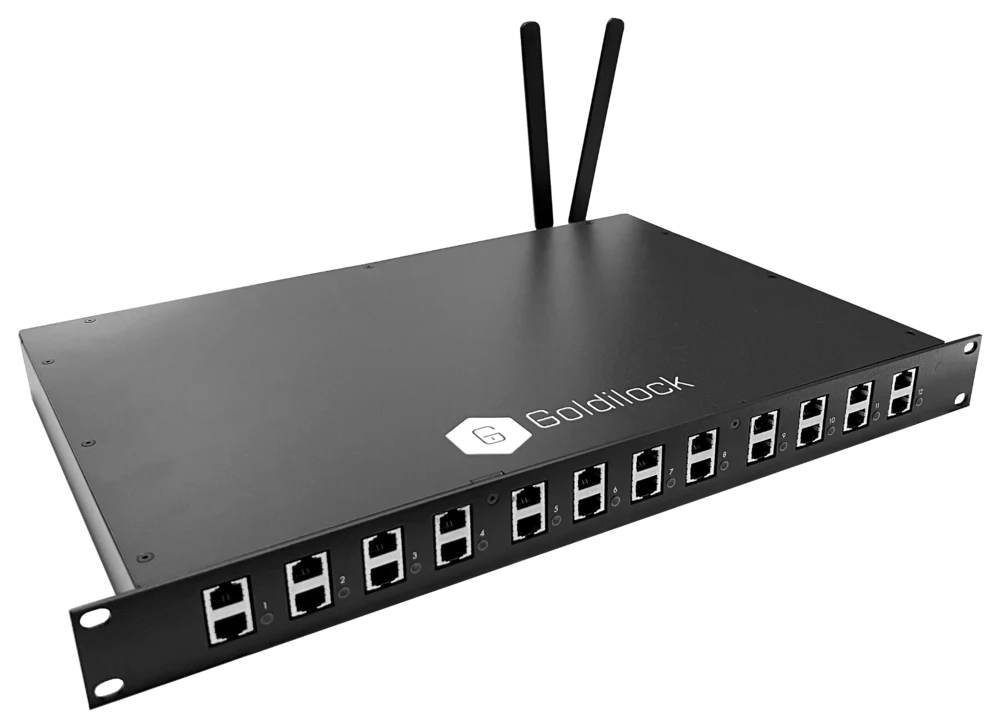 12-port rack-mount FireBreak™
Choose what crosses the break.
FireBreak is a physical connection controller for copper and fibre links. An operator can switch a selected link through an independent, non-IP command channel. The isolation point determines which functions the operator can preserve.
- Remote service
- Place the device on the maintenance route. Identify other ways into the plant before treating that route as isolated.
- Cooling control
- Keep the sensors, controller and actuators needed for autonomous cooling on the plant side. Confirm that loss of remote service leaves the rack in its intended operating mode.
- Alarms and evidence
- Trace the route from the temperature probe to the duty engineer. Test alarm delivery and confirm where readings are recorded while the service link is open.
Where FireBreak has been tested.
Goldilock took FireBreak to NATO’s Coalition Warrior Interoperability Exercise to test how it worked alongside partner teams. NATO DIANA exercise report
In Estonia, CR14 reported completing a testing programme with Goldilock at its NATO DIANA test centre. CR14’s account
Goldilock also identifies MITRE among the organisations that have tested FireBreak. Goldilock’s testing overview
Walk through your site.
Before you isolate.
Will disconnecting restore a changed setpoint?
Disconnecting the service link prevents further commands over that route. A setpoint already written to the controller may remain in effect. The duty engineer checks the active setpoint and actual temperature and restores the intended setting where needed.
Can remote monitoring continue?
It depends on how readings leave the plant. If monitoring shares the disconnected link, updates over that link stop. A separate outbound path, such as a data diode configured for temperature readings and alarms, can keep the remote team informed while the contractor’s access is isolated. Test the readings and alarm delivery with the service link open.
Which connection would you cut?
Bring a diagram of one refrigeration site. Walk through where the contractor enters, who can authorise access and how you would prove the cold room still alarms after isolation.
Schedule a demo